
I hate stereotypes…
But every now and then they ring true! Last night I went to watch the Rangers’ game at some friends’ apartment, and I ended up falling asleep on the couch. When I looked for breakfast this morning, do you know what I found in the guys’ fridge?
A lot of beer.
And not much else! They also have a pinball machine in their living room. As Chandler Bing might say, “Could it be more of a bachelor pad?” (Although I must admit… I kinda want a pinball machine for my new place now.)
The moving process is going along well. I think we’re finally done with the boring part of unpacking boxes, which means we get to focus on more fun things, like decorating. It’s always difficult for me to imagine how “big” decorations—wallpaper, furniture, curtains, etc.—will look in a room, but I love adding little touches of flair.
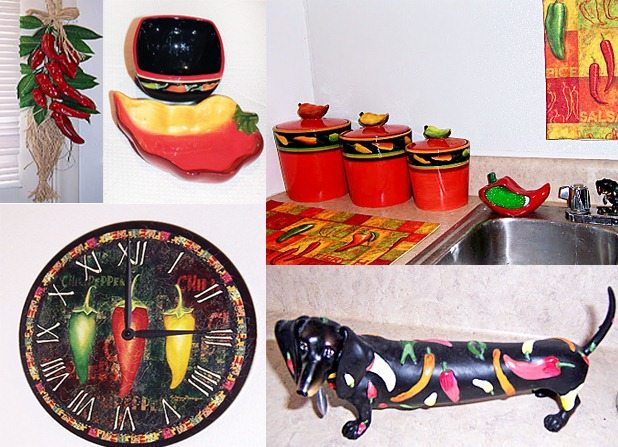
For the kitchen, I’m bringing back all the red pepper stuff I bought the last time I lived on my own. My roommate says that as long as I continue to make desserts and give her samples, she couldn’t care less what I do to decorate the kitchen!
Foodie Decorating:
Later today, I get to put my decorating skills to another use. My friend is a kindergarten teacher, and she asked if I’d like to make a special treat for her kids’ Halloween party. She still raves about last year’s Funfetti Blondies. I’m not sure what I want to make. Cupcakes? Cookies? Definitely something with chocolate.
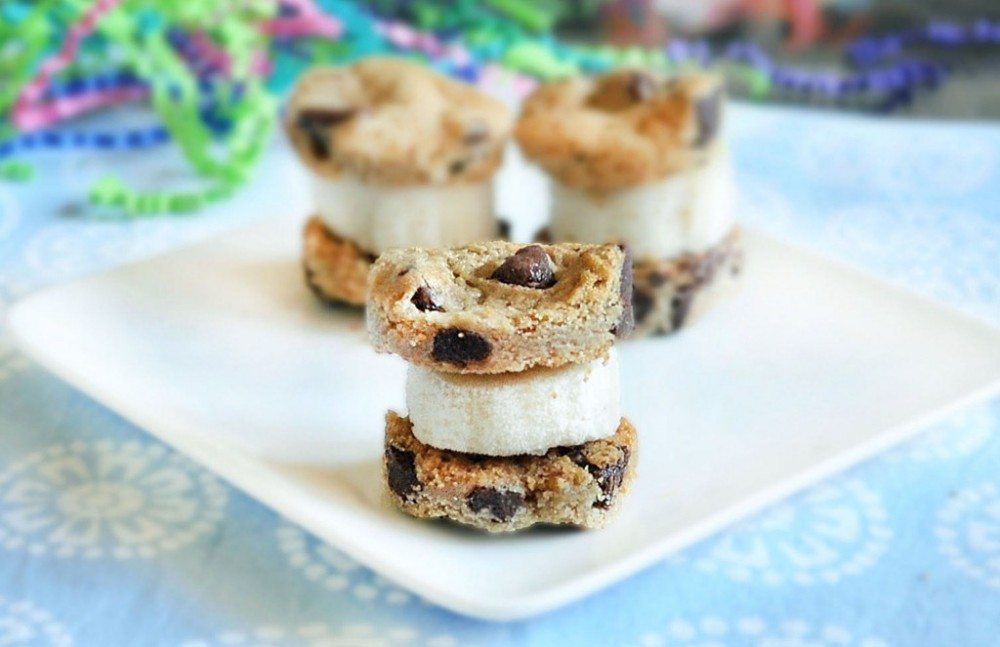
Maybe Chocolate-Chip Banana Bites.
But the banana part probably wouldn’t hold up very well, so I’m trying to brainstorm something else to put in the middle of the mini cookies. Ideally, I’d like to tie the dessert in to Halloween, too. Maybe spider cookies? With pretzel legs… Or maybe I should abandon the cookie idea and just go with cupcakes. Kids seem to love cupcakes above all else.
Do you think stereotypes are sometimes true?
I think that some are based on truth. Like Asians being smart? I’ve been blessed to know many amazing Asian friends, especially when I lived in China, and they are all very smart. My one friend—who ended up at MIT and now works for the government—actually fell asleep during the English AP test and still got a 5! (EDIT: Please read my responses to some of the comments below. Your comments made me realize that my words above–although meant as a compliment–were misguided.)
However, I don’t understand other stereotypes at all. I think the “Mexicans are lazy” stereotype is the most ridiculous and offensive one out there, because I have never met a more hard-working ethnic group. And I would like to go back in time and clock the person who first uttered the phrase, “You hit/throw/run like a girl.”
And now, since I know you’ve all been wondering only one thing throughout this entire post, I’ll answer the important question: No, I did not have beer for breakfast  . I managed to find an apple hiding in my friends’ kitchen, to tide me over until I drove home.
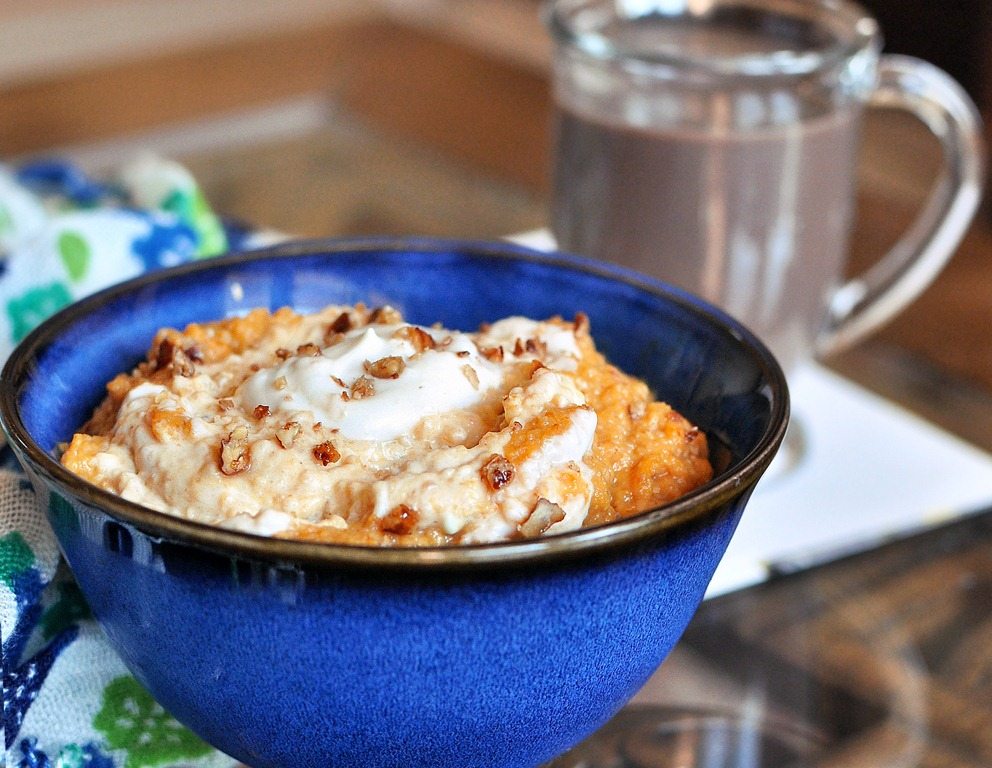
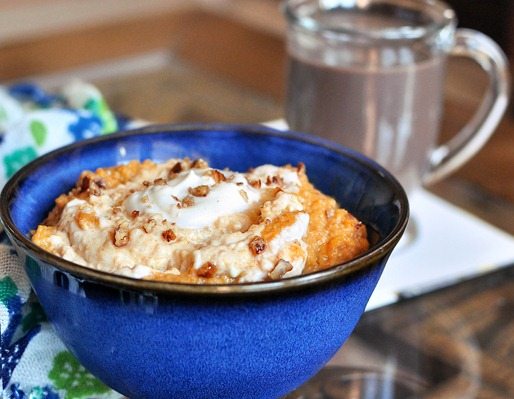
Then I threw together my favorite Pumpkin Breakfast Cereal.
How lovely to see a well-stocked fridge!













That’s hilarious – were they trying to keep the pine cone fresh?! 🙂
Stereotypes can definitely true…but they always say, don’t judge a book by it’s cover! 🙂
Hi Katie,
congrats on the new apartment and on the decorating fun.
I think your question about stereotypes is a super important one. We all need to stop and ask ourselves if our beliefs about a group are open minded, or if they are unconsciously colored by unfair stereotypes. I think even stereotypes that seem positive, like asians being smart are worrisome. The genetic component of race is largely discredited (as in, there is just as much genetic variety within one race as across multiple races), so Asian’s being genetically smarter is not true. And “Asians” is just too big a group to generalize too much about culturally. If a person meets an Asian with the automatic thought “this person is smart”, it clouds their ability to really see the person for how they are.
Anyway, I think about this stuff a lot… I’m getting a master’s degree in European Studies, focusing on immigration in/to Europe, so thinking about group stereotypes and how they affect the reception of immigrants consumes a large part of my week.
As does reading your recipes, and thinking about which chocolate goodness I’m going to make next.
Thanks for such an insightful comment.
Thanks to you (and a few other commenters), I realize that my “Asians are smart” generalization is misguided. Obviously, I meant it as a compliment, but as someone (Vanessa) pointed out, the stereotype puts a lot of pressure on Asian children to live up to these standards. Plus, as you and someone else pointed out, we should look at people as individuals. I’m actually really glad I included that sentence in my post, because your comments definitely changed my views on the matter.
Alexis. The way you use the word “race” makes me feel very uncomfortable.
When you say “there is just as much genetic variety within one race as across multiple races” I wonder how you would define race? Is race the color of your skin, the shape of your nose, the region in which you or your parents was born? When I read this two things come to mind:
– When we start dividing people into groups (“races”), we will inevitably also create a hierarchy of those groups. Some will be thought of as less than others, and in the long run this legitimiz(s?)es discrimination of those groups.
– People attributed with a “race” or “ethnicity” are never the people holding the power. White people are rarely thought of as having a “race” or “ehtnicity” in the way that non-whites are. Whiteness is very invisible and naturalised, as whiteness is currently the norm.
What matters here is that we have to see beyond the stereotype/”race”/color/shape-of-nose and think about who benefits from the creation of these stereotypes. Who gets “raced”? Who gets “stereotyped”? Who is never thought of as having a “race”? Who transcends stereotyping? Essentially this creation of difference between people has to do with power, and the people holdign the power is somehow thought of as “natural” or “invisible” in terms of “race” and “ethnicity”.
So think twice before stereotyping, you’re not only limiting the person you stereotype but also supporting systems that eventually create discrimination and racism.
(For reference, see Richard Dyer’s “White”)
Sometimes, I do think stereotypes are true! I like the ‘Asians are smart’ one (mostly because I’m Asian, haha ^^) but one I don’t like is that “Mexicans are poor”. I had a Mexican friend who is actually rich(-ish)! She can afford three pairs of $120 shoes, and one or two North Faces and other stuff. The only thing is, is that she lives in an apartment.
“Asians are smart” stereotype: Disproven. (see above)
I said “I like that stereotype”, I never that it’s true.
First off – thanks for all your delicious recipes. I’ve read your blog for a while, but never felt the need to comment. The controversial subject of stereotyping ultimately piqued my interest.
I agree with what many of the above commenters have said about being wary of “positive” stereotyping as well. Any blanket statement about a specific “race” or “ethnicity” (quite loaded terms in and of themselves) can come across as offensive, regardless of the intention. Especially in such a globalized, internet accessible world, crosscultural interactions and physical migration problematize the neat culture categories we find it easier in which to view the world.
I think it’s also important to think critically about the historical and especially political context within which stereotypes are created, reinforced, and perpetuated. Discriminatory government policies would not be effective or gain support without the common practice of dehumanizing the “other.” Likewise, the “model minority” stereotype ascribed to Asians in America is often used as justification for the mentality that all immigrants should be able to pull themselves up from their bootstraps and achieve the “American dream.” This perspective does not take into account specific immigration policies, and the fact that the stereotype is built around a small population of East Asian immigrants to the US that came with preexisting higher education and wealth.
The subject matter is obviously heavy and elicits quite a varying response. I think that the more interesting question is not whether or not we believe a stereotype to be true, but how and why we have stereotypes at all?
Like Emily, I’ve also been reading but haven’t commented much. Emily is absolutely right: Positive stereotypes are still stereotypes. Negative stereotypes are still stereotypes.
You seem to be conflating physical sex with cultural gender expectations as well as the social construct of race with cultural values associated with ethnic identity.
Above all things, remember that sex and ethnicity do not determine a person’s intelligence, skills, interests, or personality. The way in which cultural norms surrounding sex (gender roles, gender norms) and ethnicity (cultural values in one’s community and family) interact with one on a societal, institutional, and individual level mold us and effect our perceptions of ourselves and others’ perception of us.
Thanks so much for all the info. I hope you did see my comments above that I do realize my off-the-cuff remarks were misguided. I really do appreciate the time you (and others) took, and it opened my eyes. Now, when I talk about my smart “Asian friend” I will only refer to her as my “smart friend”! She is an individual, and I am sorry for my generalizations.
(Also, I had to take your links out, because my wordpress account marks many-link comments as spam. But I did receive them all :).)
Yeah, I’ve noticed that with leaving links on blogs. Anyway, it might help to update the post a bit. After I wrote this, I read all the comments, and it seems like more will keep coming.
Sociological Images is pretty much the best blog ever, even though the topics they post about will make you headdesk a bit (racist Halloween costumes, sexism in the media, etc.)
Anyway, hope you enjoy the links (ABC is an especially witty and moving comic) and carry on with the chocolate and oatmeal!
I actually did edit it, right after responding to your first comment. And I’ve written an apology in to today’s post as well.
Wow…well said!
Have you ever read Malcolm Gladwell? He contends that at least part of the Asian “smart” stereotype is a result of a) an intense educational system and high value of family honor, and b) a language structure that promotes a unique way of thinking about things like numbers. But that’s a good stereotype anyway. =)
I guess all stereotypes have their “root,” but they’re certainly not all fair. Consider the stereotype of women drivers. Chances are, this was either projected onto women to make men feel better about letting them drive…or that women were actually bad drivers due to a long history of being excluded from mechanical activities. Unfair either way.
I think the best thing to strive for is to acknowledge those roots, but don’t apply those stereotypes to ANYONE you meet. Every individual should have the opportunity to be their own person.
I had that for breakfast this morning!
Oh please do some Halloween desserts! I keep seeing those cute spider cupcakes that are essentially a cupcake with pocky stick legs and I’m certain you could make a healthier version of that! Do it CCK!
Oh Katie,
Reading this, I was struck by two things:
1. People need to stop being so easily offended. Not just here on your blog, but in the world in general. It seems like someone gets offended at ANYthing these days, to the point where people are afraid to speak! Lighten up, people. Take a joke, have some compassion, and realize that people are meant to speak what’s on their mind, without having to worry about censoring every single syllable first!
2. I am so impressed with how you handled the comments. Most people, when told they were wrong, will get defensive and angry and will respond in a negative manner. But you were gracious and courteous and actually admitted you might have been in error. I have always admired your blog, but I now think even MORE highly of you, if that’s even possible.
Totally agree^^
Observer,
Very few people here responded to Katie in a way that was aggressive or insulting. Most just very respectfully shared why stereotypes, even “positive” ones, can be detrimental to people.
We have a responsibility to calmly and thoughtfully express when someone is using stereotypes. No one learns any better if no one says “hey, that’s hurtful and here’s why.”
PS: we don’t need to “lighten up” or “take a joke”. This isn’t comedy and only by drawing attention to these issues in an mature way can we cause society to change. It drives me batty that people feel the need to tell those of us who care about certain important social justice issues (animal rights/veganism, feminism, racial equality, LGBT issues, rape culture issues) that we’re just too sensitive and easily offended. Words have power and words express what our culture believes and how it works.
I know Katie gets that and that’s why she responded with her usual grace and tact.
You’re my hero in this post, Melissa. Stay fabulous.
I have to agree with “An observer.” I am a vegan now, but I probably would’ve become one much sooner if it hadn’t have been for first meeting close-minded and easily-offended vegans that turned me off of the whole movement and made me THINK I never wanted to be like that.
When you’re that easily-offended, and you can’t laugh at yourself, you hurt your own cause.
I have found that when I’m able to laugh at myself, others are more at ease around me and thus more apt to listen (open-mindedly) to my message.
I agree! People, please- have a sense of humor! That doesnt’t mean i am in favor of these stereotypes, not at all!
Perpetuating derogatory stereotypes is NOT the same as “having a sense of humor.”
I would also like to point out that very few of Katie’s gentle critics were calling her “wrong,” but merely using this opportunity to offer a differing perspective. Before I took several courses on Ethnic Studies, Global Poverty, Anthropology, among others, I did not have the resources or insight to analyze these complicated matters. I am the first to admit my academic bias and privileged background from which I have gained access to this knowledge (and the limitations that come along with that) as well as realize others may not have had similar experiences. I also would argue that institutionalized education is far from the sole route to gaining knowledge, especially with the increasing availability and, arguably, democratization of information via the internet.
We obviously all have internet access and as intelligent people realize we are on a public forum in order to facilitate the diffusion of our opinions and beliefs. Often misconceptions about the world stem from a narrow perspective, such as the number of comments by people that use a single example of their “Mexican friend” can be extrapolated and applied to an entire ethnicity. Whether or not the characteristic carries a positive or negative connotation in our society, the fact is that it is a limited and ultimately constricting viewpoint.
Making jokes regarding preexisting stereotypes is generally widely accepted. I would argue it is the compassionate person that realizes these jokes come at the expense of entire groups of historically margainalized and people that have often been discriminated against solely on the basis of race/color/creed/gender/etc, and not the person that excuses one making a joke. (Note: I am replying to the phrase “lighten up” regarding jokes, not arguing Katie was making a joke, which I do not believe she was.)
True, people get easily offended. However, I do not think this is a bad thing. If anything, “taking offense” is proof that people are aware of their human and social rights and do not stand for the violation of these rights, even if it is in what you consider a harmless fashion. Social change never came because people were afraid to point out blatant ignorance that was the de facto racial policies of the US. I would keep some of these points in mind next time you have the desire to dress up like a Native American for halloween, or don’t understand why nobody laughs at your Speedy Gonzales impression. Hint: The “I have a black friend” card won’t help you out. BE OFFENDED. I bet you are after reading this.
TL;DR: Be offended, be be offended.
“Be offended, be be offended.” Thank you for this, esp. the last paragraph! You and Melissa have had the best comments.
Food blog or no, we all have a social responsibility. I think Katie has handled this incredibly well. I have commented on recipes before, but the reason I wanted to comment on this was that Katie is obviously an intelligent and caring person, and I wanted to share some resources I’ve found helpful in the past for understanding the role of class/sex/gender/ethnicity and stereotypes in the past. (Cultural Studies BA, Japan Studies MA, female, and now experiencing what it’s like to be an ethnic minority in Japan as a woman.) Even though I took Asian American history coursework, I don’t even think I understood how awkward and hurtful even positive stereotypes can be until I moved here and they became directed at me.
Anyhow, even though I really came out of the woodwork for this post, I’m going to try harder to leave feedback for your recipes! I’ve only just discovered this blog thanks to Freshly Pressed, and I’ve been trying to sort out how to make some of these in Japan, since the ingredients here are a bit different. Alishan jumbo oats (even bigger and tougher than Quaker) make good boatmeal but don’t stick together well for the cookies, and I hate to be that commenter who makes the “I changed something; why didn’t it work?!” comment, even if it’s really about availability and not just changing things for the hell of it. 😉
I know that you meant to be complimentary, but the “Asians are smart” stereotype has a bit of a backlash. I went to high school in a predominantly Asian area, and while there were highly intelligent people at my school, it didn’t matter where they came from, rather, it was their motivation and dedication to making the most of their intelligence that truly made a difference. The problem I saw with that stereotype was the consequence for those of us that do not come from Asian backgrounds. With the perpetuation of the stereotype, there was almost a hierarchy, with students from other ethnic backgrounds at the bottom. I fought for four years to be recognized as intelligent, Caucasian or not. There was even an NPR program regarding my school, titled “Are Asian Students Smarter?” which, as you can imagine, was unbelievably painful to those of us who aren’t Asian but work just as hard.
I am unbelievably blessed to come from the circumstances that I do, and I’m not trying to insult anyone. I know that I didn’t have to work my way up from nothing to make it in this country, but I also know that I still work really hard to secure a future for myself. I also don’t want you to feel attacked by my words at all, I just want you to know that when that stereotype is prevalent in a community, even that of a high school, it is used to promulgate prejudice and exalts one group while dismissing the potential of another.
I’m not going to stop reading your blog, I think you are unbelievably adorable and have a great take on life and health, I just wanted you to know that after four years of fighting the “Caucasians are dumb” stereotype, I’d rather focus on the attributes of an individual that works hard than a generalization about a group.
Did you see the edit in my post, or some of my responses to others’ comments above? I do now realize it was wrong to generalize.
I did, and I think you did a beautiful job handling the situation-I’ve been reading for long enough to know that you’re a sweetie and wouldn’t have said something with the intention of hurting anyone! Like I said, I’m not going to stop reading, impossible actually, seeing as I eat chocolate for breakfast quite a lot 🙂
I just wish you weren’t someone who had to “realize” this. It should be obvious. Please take some time to think about the world–maybe as much time as you take to think about food.