
Does healthy eating = low-calorie eating?
It can… but it depends a great deal on the individual person. In many cases, I’d argue that a low-calorie diet is not ideal for optimum health (such as the case of an athlete, a growing child or teen, an underweight or healthy-weight adult, etc.).
Today’s post is going to be a little different.
It’s a topic about which I’ve been meaning to write for quite a while; ever since there was a bit of drama and confusion over it in the comment section of this post.
You see, I don’t want to send out the wrong message or give people the impression that I only eat low-calorie foods… or that anyone else should only eat low-calorie foods if he/she doesn’t medically need to do so. My website is not a “this is what I ate today” food blog, and the photos you see on this site are usually just of the recipes (as opposed to the entire meal I might’ve eaten along with the recipe. I can tell you I hardly ever eat just a bowl of oatmeal for breakfast!).
Due to the fact that healthier foods are often lower in calories, and because I know a large number of my blog’s readers are watching their weights, many of the recipes on this blog are—or can be—quite low in calories.
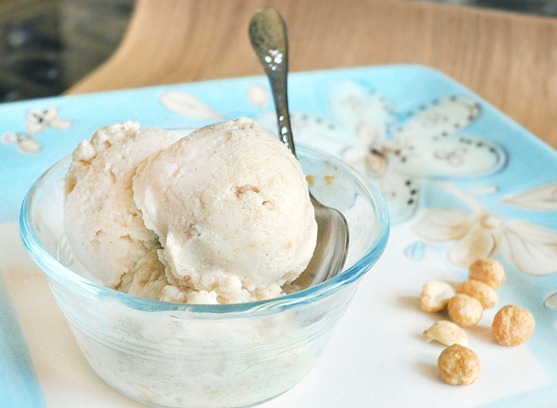
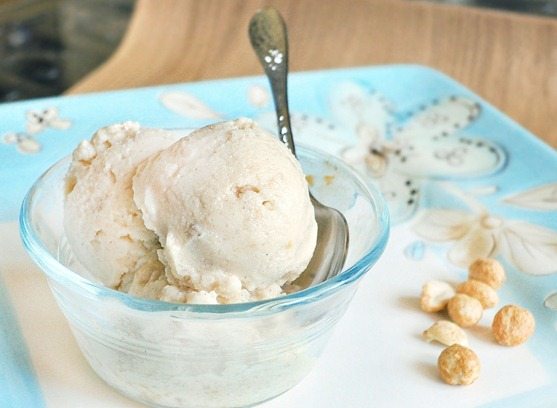
In the photo above: Low-Calorie Peanut Butter Ice Cream
To help the large percentage of my readership that doesn’t want the extra calories, I try to always point out when lower-calorie options exist in my recipes (such as when one can sub applesauce, how to make a recipe lower in fat, etc.).
However, the cool thing is that many of my recipes are easily adaptable to almost any diet. Perhaps I need to pay better attention to the other portion of my readers; those who do not have weight to lose?
It’s a common (and dangerous) misconception that a person who needs to gain weight or eat a high-calorie diet must consume exorbitant amounts of junk food in order to meet this goal. You can meet your nutritional needs without downing milkshakes at every meal, and you’ll probably feel much less sluggish.
Today, I thought I’d highlight a few of the tricks I use to calorically bulk up my food while still being healthy.
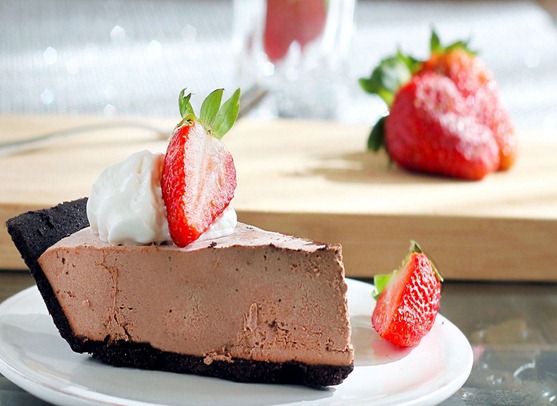
In the above picture: Chocolate-Strawberry Truffle Pie.
1. Focus on calorie-dense foods.
Eat these first at a meal, so you don’t feel too full before you’ve gotten in enough calories. Here are some calorie-dense, yet healthy, foods:
- all nuts and nut butters
- oils (such as olive, sesame, or coconut) in their pure form (not the hydrogenated stuff they put in packaged goods!)
- avocados
- Thai coconut meat (really good in smoothies, pies, or puddings)
- dried fruit
- canned coconut milk
- giant bowls of pasta (my favorite!)
- dark chocolate (oh wait, that’s my favorite!)
Raw recipes are often calorie-dense. Here are my favorites.
2. Don’t skip the veggies
…because you’re afraid they’re too low-cal. But do be sure to not just eat them plain and steamed. Try sautéing or roasting with a generous drizzle of olive or coconut oil (so so good).
3. Bigger portions.
For example, I post oatmeal recipes that are for one serving. But when I make them for myself, I always times the recipe by 1.5. Try it sometime… you probably won’t even notice you’re taking in more calories!
4. And eating more often.
Instead of three huge meals per day, space it out with 5-6 smaller meals and snacks throughout the day, giving your stomach a chance to digest. Personally, my job as a recipe developer means I never stop snacking! Chocolate is always close to my heart greedy fingers.
5. Non-healthy treats… sometimes.
I’d say I probably eat healthy foods 80% of the time. But does that mean I’ll turn down a friend’s cookies that she veganized just for me? Or Hangawi’s incredible cheesecake in NYC? No, it does not. (I probably should get a post up about this topic, too… but not today. I think I’ve already talked your ears off enough for one day!)
Do you eat a high-calorie diet? A low-calorie diet?
Or maybe you have absolutely no idea how many calories you consume! Please take an introspective look at your life and make responsible food decisions for you. If that means eating a low-calorie diet, my recipes are here to help. But if that means not eating a low-calorie diet, please take advantage of some of the higher-calorie options listed both in this post and in my recipe posts!
For more, see the following: High Calorie Recipes.










Such an excellent point that overweight people are not the only people who should be worried about eating healthfully. It’s that kind of thinking that causes people to fall into yo-yo dieting patterns.
I also find it fascinating that people are so accusatory of you because you are thin. Why is there so much suspicion about thinness? Like the only people who are thin have eating disorders? Crazy! I like your recipes because they are nutrient-rich and dairy-free. Keep up the good work!
Katie
It’s too bad so many people are judgmental. I am very underweight due to several digestive problems which make it difficult for me to want to eat enough. I continually count calories, fats etc and track my eating with software not to “diet”, but so I know where I am deficient and how much more I need to eat at the end of the day. So, while I enjoy plenty of calorie dense foods with good fats, such as nuts, I also eat many small meals and I get more satisfaction (and nutrition) from eating a plate full of low cal veggies (which I truly love) rather than smaller portions of simple carbs like rice (which my dietician promotes). Then I snack on lots of fun yummy bites, a lot of which are your recipes (or inspired by them). Looking forward to “treats” helps stimulate my appetite. My main point is that I use the nutrition info to help me keep up–it’s not just for those watching their weight. Thanks for providing it.
Finally, I want to say, for those of you checking out people at the gym/grocery store and making assumptions about their eating disorders, there are some of us who are struggling with health issues that are physical, not just emotional, and these judgements can be very hurtful. I still excersize daily for many reasons, such as improving my mental state and digestion, and I find myself shying away from the gym so as not to have to endure these judgements. I know I look too skinny and get tired of having to think and talk about it.
Katie–I love your ideas and I have a bowl full of choc fudge pie filling in the fridge calling to me… 😉
i’m REALLy struggling now because I have a lot of weight to gain ( well, about 15 lbs anyway), i’m not exercising (what a failure..i SHOULD), and have bad bad digestion…
if anyone can email me, please do …i need specific plans 🙁
You are wonderful just the way you are! Remember that 🙂
Katie,
Can’t tell you how happy I was to read this post. Due to health reasons that arose for me last march, I had no choice but to cut out all sugars and grains! Being gluten-free, almost vegan, and soy-free already, this narrowed my food options immensely and resulted in a high vegetable and VERY high fat diet (which ended up meaning higher calories, too!). Of course, it’s all very healthy fats – I eat a ton of soaked and sprouted nuts and seeds, oils, avocados, and coconut – and it usually amounts to a few hundred grams of fat per day! That also leaves me with 500-1000 more calories than I used to eat! Here is the most incredible discovery I’ve made on this diet: I’m thinner, lighter and more fit than I’ve ever been in my entire life. I’ve always been petite and thin, health conscious, and a daily exerciser and yet the moment I began this diet, stored fat quite literally melted off of me. I was never even trying to lose weight. It seemed like my body began working more efficiently than ever – actually USING everything I fuel my body with as quality energy.
I am living proof that eating a TON of fat and calories from whole food will NOT make you fat. In fact, it will probably make you look and feel better than ever. I now become so frustrated when I see how our culture has made people so afraid of fat and calories, because most of the information we’re bombarded with regarding maintaining “good health” is actually quite wrong… and the calories and fat with which we do fuel our bodies isn’t actually real “food” at all. No wonder we have such epidemics of obesity and disease today! Our bodies are completely stumped by what to do with the strange things we put in them! Hopefully, with posts like this one and more voices like ours speaking up, we’ll be able to erase so many of these lies and myths Americans have been fed for so long.
Thank you so much for this post and keep it up!
Much love,
Desi
Desi- this is so encouraging to me. I used to eat like 1000 calories and run 10 miles every day. And I would lose about 2 pounds per week. Well of course I got injured and now that I can’t workout, I have had to look at my diet. I will do the elliptical for 30 mins a day but I chase small children all day, so I am hungry all the time. To the point where I don’t even taste the food I eat, I just jam it in my mouth. Anyway, hiking my calories has also resulted in me losing weight, and it’s easy! Your weight should be easy to maintain, not difficult!
Hi Desi,
I too have had too cut out all sugars and (almost) all grains (and eat them in very small amounts). I am gluten- and wheat-free, soy free and almost vegan (all except eggs) also. Your diet sounds very similar to mine! I eat lots of nuts, seeds, coconut!, and vegetables prepared with olive oil. My fat intake is around 150-200g a day (when I count it up), but my energy intake is only a bit over what is recommended for me.
I know that even if a person doesn’t appear ‘fat’ on the outside, their internal organs can still be storing fat. Have you found anything about the long term effects of a diet like ours?
I love this post! As a new reader, I have been thoroughly enjoying all of your recipes and posts. I don’t eat a super low calorie diet but because of my activity level, most of my calories are focused on mini meals and I don’t have a lot to spare on nutritionally deficient desserts. Your blog has showed me that I can still have dessert and it can be healthy. Personally I don’t like a high calorie dessert anyways so I’m loving the lower calorie options and tend to go somewhere in the middle of the low and high calorie versions. I’d just say keep doin what your doing because people will always find fault with something but as long as you’re happy and healthy and encouraging that in your blog, that’s all that matters 🙂
also, I hope your blog will help me getting back down to where I was, I think I drank a lot of muscle milk for women, and ate a lot of almonds as well. I remember I wasn’t afraid of healthy fats, because I remember reading in order to lose weight one must take in good fats.
I recently lost my grandfather which I think is why I have been eating as much as I have, I just find comfort in food and baking.
Everybody measures their intake/output/progress with something… Calories on a plate, the size of their clothes, the weight on the barbell, the oz or g, the number on the scale, all going up or down or staying the same. All in all, just like Garfield, when something healthy is “low-cal” I’ll probably be inclined to eat twice as much of it!
I’ve been counting calories for years, then I switched to measuring my macros (carb/fat/protein), then I switched to eating pure and clean foods and paying attention to only eating when I’m physically hungry and stopping when that feeling is gone. That’s progress for me — to be less obsessive-compulsive about the numbers, and to measure progress by strength, attitude, endurance, and eating for fuel (which can be be out-of-this-world-yummytown!).
I feel best about myself when I’m eating clean and lifting heavy. The rest seems to take care of itself in due course.
As a registered dietitian with many years experience I have learned that everybody is different when it comes to metabolism/ calorie needs and diet compostion. Even in the world of clinical nutriton there is controversy and discussion on how best to determine somebodys’s calorie needs. Diets are alot like medications- same thing does not work for everybody. I agree completely with what Katie posted on how to gain/avoid wt. Good work
so when you eat 20% unhealthy, do you eat vegan? there are such things as unhealthy vegan food
Yes :). I am a vegan first and foremost for ethical reasons, so I do always eat vegan.
I eat a very low calorie, high protein, low carb, low fat diet. I had weight loss surgery last year and have lost 85 lbs to date. I still have 40 lbs to go to hit my goal of 145, because that’s the weight that a person my size is supposed to have (according to the docs). I’m fairly happy where I am, but I want to keep trying and getting down more and more.
I enjoy most of your recipes, and I do have to alter a bit to keep the calories down (I use a calorie counter that I can input recipes into and it gives me the nutritional content). I actually made Hot Chocolate Fudge Babies yesterday and had one for a snack today, and it gave me protein from the walnuts and fixed my chocolate craving. I’m even getting my husband to like them and he’s vehemently not vegan *lol*. I’m wearing him down, though.
Wow, 85 pounds is awesome. You should be so proud of yourself!
I have a long way to go still, but Katie’s site has been so helpful to me so far. Before finding it, life was such a struggle. I hadn’t had a treat in MONTHS and was feeling so deprived :(. And now I’m still losing weight, yet I can eat some chocolate again.
I know it sounds silly, but Katie your site really did SAVE MY LIFE!!!
Thank you, Sue. 🙂 I was a size 22-24, and I’m down to a 12-14 now. It’s SO weird looking at myself in a mirror and seeing what I thought was the same person, then looking at pics and seeing how much different I look.
I still eat chocolate – and it’s thanks to Katie that I found the vanilla stevia drops which really helped me SO much, so I know how you feel about the whole “Katie saved my life” thing 🙂
WOW!! GO SAPPHIRE! I bet you look beautiful! Seriously, you are an inspiration. Any tips for me ( i want to lose the final 10 pounds)? I would love to hear them and good luck with the remainder of your journey 🙂
Thanks, Sarah! Like I said in the first post, I had WLS back in July. I do Zumba as often as I can, switching it up with weight training and other things. I sometimes shock my system by actually OVEREATING, because if you lose a lot of weight, your body’s metabolism thinks that you’re starving, so it stores everything as fat. If you over eat once a week (not by a whole lot though), then your body’s like “wow! We’re okay!” and it kinda resets the metabolism and you keep losing. It helps to keep a food journal, and I mean it REALLY helps. Knowing your BMR (basal metabolic rate) also helps you to know how much you need each day and how much you need to take in to lose the weight. There are lots of calculators out there to help you find out what your BMR happens to be.
I try not to drink while I eat, and if I drink something, it’s usually water about 15 minutes before a meal or an hour afterwards. I drink protein shakes, my protein is usually over 70g per day, with 100g (or less) carbs, and 30g or less fat. And I don’t stress out if I get stuck. Stress makes you release cortisol, which makes you hold onto fat.
my email is blueroses_78@yahoo.com if you want to talk or need some support or motivation 🙂
I had weight loss surgery about 3 years ago, and have lost over 200 pounds. I have also had one skin removal surgery so far, with fantastic results. I have noticed lately that my weight is creeping up again as my appetite is back in full strength following surgery at this point. This site sounds interesting in my goal of finding good ways of eating great food but keeping the calories within what my body needs to maintain my loss. I would welcome any support or weight loss buddy.
Wow! You’re so right…
I used to have anorexia/orthorexia, and i had so much difficulty losing weight on a ‘healthy,’ portion-regimented diet; and yet always felt so deprived and stressed out (though I did allow myself small portions of my 2 favorite foods daily).
I did notice that once I began healing, and started eating until I was Truly satisfied, and incorporating more energetic activity to balance out my food intake, I lost weight faster and was able to keep my weight down to a normal level (mostly w/a flat stomach) and felt much, much happier and calmer
(made huge efforts not to stress out bc I’d learned by then that stress can sabatoge weight loss)
Forgot to mention that I was eating more of foods that were actually healthy for me; and trying to save the unhealthy foods for when I craved them but at the same time trying not to stress out
Hi Annie, is it possible you can email me? I am so glad I read your comment today,as that is exactly the eating disorder I am currently suffering from and just didn’t know what it was, till today. Any advice/help is appreciated; missjones1223@gmail.com
Well done Sapphire!
I had surgery 2 years ago and it was the best thing I ever did! I’m down 120ish pounds.
I’m so thankful for Katie’s blog as it’s allowed me to satisfy my sweet/chocolate cravings in a healthy way. :0)
Thanks 🙂 Congrats on your amazing loss! 120 lbs is awesome!
Awesome job 🙂
Thanks, Lisa 🙂
Thanks so much- super helpful! tomorrow is day 1 in the food journal 🙂
I am SO VERY HAPPY to say that i have NO IDEA how many calories I’ve had today, nor how much I weigh. For years I was obsessively counting calories for everything I ate, always trying to keep it as low as possible (I’d have around 1500-1800 a day) even though I’ve never NEEDED to loose weight. I guess it’s some sort of passive-agressive eating disorder that stalks a lot of women, I mean it’s hard not to when every single magazine and commercial out there is somehow implying that weightloss is what women should be spending their time thinking about. So what happened? Well, I just decided to stop. It took some time before I could stop that mechanical ticking calorie-counter in my head, but now it’s rarely ever there. I’m 5.11″ and when I was on my calorie hunt I was a jean size 27″, now (about a year later) I’m a 29 or 30″. I feel happier, and I can enjoy eating what I’m in the mood for instead of what my calorie counter tells me.
To answer your question, Katie, I have no idea wheather I’m on a low or high calorie diet. What matters to me is that it’s a diet full of whole grains, fruit, veg protein and lots of happy treats – and absolutley NO counting!
A friend of mine had “Riots, not diets” written across her wall. I like that.
well said – enjoy your freedom and well-being 🙂 You’ve found a happy balance, and that’s plain awesome.
I dont count calories at all — I believe quality supersedes the numbers and we should all be a bit more intuitive about what we consume. However, some people need to tally the calories given their specific conditions.
Katie, I definitely think that you should consider posting more high-cal recipes — lots of people are vegan for ethical reasons, not because they need to lose weight, thus I think you’d have a large audience for it 🙂
And I think you should post up some of your favorite giant pasta bowl recipes!!
AGREED!!!
The funny thing is that many of my recipes already ARE (or can be) higher-cal. I definitely need to do a post about it, though! Some of my favorite recipes on the blog are high-cal ones (a lot of the raw recipes, and the pb cookie dough cookies!).
I meant more like, high-calorie recipes that could constitute a meal — I know it’s primarily a dessert blog, but even stuff like oatmeal, pancakes, and shakes for a substantial breakfast 🙂
Thank you for responding!
I am with Erica! More substantial breakfasts! 🙂
There are lots of oatmeal, pancake, and smoothie/shake recipes on here. What’s to stop you from combining several of those to make a substantial breakfast?
Good for you lovely 🙂
I don’t count calories, but I can definitely tell when my body is asking for fewer calories after an indulgent weekend or more calories when I have more intense workouts. I love the idea of calorie-dense whole foods for times I need to get some extra fuel – bring on the pasta, olive oil and other goodies!
Really great Katie. There will always be those readers who have inner anger/frustration/unhappiness with THEMSELVES and they want to blame someone because it is easy.
good for you and stay just the way you are. 🙂